
Contact Us
Email: infosotonsavannahs@gmail.com
Tel: 07870862558
Address: 22 Carpathia Drive, Southampton, Hampshire, SO14 3GU
Questions and Answers
All you need to know
Frequently Asked Question
Bengal × Savannah Hybrid Encyclopedia: The Complete A–Z Guide
This comprehensive reference is designed for owners, breeders, and enthusiasts. It focuses on a welfare-led, evidence-based approach to understanding the unique intersection of Bengal and Savannah genetics.
A — Aggression
Q: Are Bengal × Savannah hybrids aggressive?
A: No. Aggression is not a breed trait. Most defensive or reactive behaviors stem from fear, overstimulation, boredom, pain, or a lack of established boundaries. Correct enrichment and a stable routine resolve the vast majority of cases.
B — Biting (Play or Overstimulation)
Q: Why does my cat bite during play?
A: This is usually due to "over-arousal." This mix has a high prey drive; if play becomes too intense, they may nipped. Hands should never be used as toys. Always use wand toys and end the session before the cat becomes overly frustrated or frantic.
C — Climbing Everything
Q: Why does my cat climb doors, shelves, and curtains?
A: This mix is vertical by nature. They seek high vantage points to feel secure. To protect your home, provide tall cat trees and wall-mounted shelving. Climbing is a biological necessity, not "naughtiness."
D — Destructive Behaviour
Q: Is my cat inherently destructive?
A: Usually no. Destructive behavior (chewing, scratching furniture) is typically a sign of under-stimulation. Increase structured play, use puzzle feeders, and ensure they have appropriate outlets for their energy.
E — Excessive Energy
Q: My cat never seems tired — is this normal?
A: Yes. These cats are the "athletes" of the feline world. Expect and plan for 30–60 minutes of active play daily, ideally split into several short, intense sessions.
F — Fearfulness
Q: Why is my cat suddenly hiding?
A: Hybrids are highly sensitive to their environment. Changes in noise, new visitors, or a shift in routine can cause stress. Provide "safe zones" (like a high shelf or a quiet crate) and never force interaction.
G — Grooming (Over-grooming)
Q: My cat licks themselves excessively — why?
A: Over-grooming can be triggered by stress, allergies, boredom, or skin irritation. Always rule out medical causes with a vet first, then assess if the daily routine is providing enough mental engagement.
H — Harness Walking
Q: Can they be harness trained?
A: Yes, many excel at it and enjoy the mental stimulation of the outdoors. Training must be slow, positive, and strictly non-forced. Use a secure "H-style" or jacket harness designed for escape-artist cats.
I — Indoor Living
Q: Can they live indoors only?
A: Yes—safely and successfully. In fact, indoor living (with a catio or enrichment) is often safer. They thrive indoors as long as their vertical and mental needs are met.
J — Jumping
Q: Is it normal for them to jump onto the top of the fridge?
A: Yes. Their powerful hind legs and long bone structure allow for extreme vertical leaps. Secure breakables on high shelves and be aware that "out of reach" for a standard cat is easily accessible for this mix.
K — Kitten “Bad Behaviour”
Q: My kitten is wild — will they ever calm down?
A: Adolescence (6–18 months) is the most intense phase. While they settle with age, they will always remain active. Consistent boundaries and routine during this phase are critical for a well-adjusted adult.
L — Litter Tray Problems
Q: Why is my cat missing the tray?
A: Common causes include dirty trays, a change in litter brand, stress, or urinary tract infections (UTIs). Rule out health issues with a vet immediately, as hybrids can be prone to "holding it" if they are stressed.
M — Meowing / Vocalisation
Q: Why does my cat talk so much?
A: Both Bengals and Savannahs are highly communicative. They use chirps, trills, and yowls to "talk" to their owners. This is usually interactive and social, not a sign of distress.
N — Nipple Suckling
Q: Why does my cat suck their own nipples?
A: This is a self-soothing behavior, often linked to early weaning or stress. It is usually harmless habit-forming behavior. However, if the skin becomes inflamed, red, or sore, seek veterinary advice.
O — Obesity (Fear of Being “Too Thin”)
Q: My cat looks very slim — is that unhealthy?
A: No. A lean muscle mass and a visible "tucked" waist are the hallmarks of a healthy hybrid. Over-feeding to make them look "large" or "cuddly" leads to joint damage and metabolic disease.
P — Play Aggression
Q: Why does play turn rough so quickly?
A: The play session is likely too long. If the cat’s pupils are fully dilated and they are "pouncing" on feet, they are over-stimulated. End the play while the cat is still successful and calm.
Q — Quiet Phases
Q: My cat is suddenly sleeping more — should I worry?
A: It is normal for them to have deep sleep phases after growth spurts or high-activity days. However, sudden lethargy combined with a lack of appetite requires a vet review.
R — Roaming Urges
Q: Does my cat need to roam outside to be happy?
A: No. Free-roaming is dangerous for high-value, curious hybrids. They are prone to theft, accidents, and getting lost. Supervised outdoor access (catios or harnesses) is a great middle ground.
S — Spraying
Q: Do these hybrids spray more than others?
A: Neutered, low-stress cats rarely spray. Most cases involve intact (unneutered) cats, territorial insecurity (stray cats outside), or significant household stress.
T — Training Difficulties
Q: My cat is smart but ignores me — why?
A: Intelligence does not equal obedience. Hybrids are independent thinkers. Training must be "What's in it for me?"—keep sessions short, fun, and highly rewarded with treats.
U — Under-Stimulation
Q: How do I know if my cat is bored?
A: Signs include pacing, over-vocalizing, destructive scratching, or "stalking" other household pets. Increase mental challenges like food puzzles.
V — Vet Visits
Q: Why is the vet so stressful for my cat?
A: These cats are highly observant and notice the "carrier" immediately. Use "carrier training" (leaving the box out as a bed) and seek out "Fear-Free" certified vets who understand hybrid temperaments.
W — Water Fascination
Q: Why does my cat try to get in the shower or play with the tap?
A: Many hybrids have a natural affinity for water. It is a form of sensory stimulation. Providing a cat water fountain can satisfy this curiosity.
X — “X-Factor” Behaviour
Q: Why is my cat so different from a standard tabby?
A: You are living with a highly athletic, intelligent, and interactive animal. Comparing them to a standard domestic cat is misleading. They require more "parenting" and engagement.
Y — Yowling at Night
Q: Why is my cat noisy overnight?
A: This usually means they had too much daytime sleep or didn't get a "big kill" play session before bed. Adjust your routine to include a vigorous play session followed by a meal right before you go to sleep.
Z — Zoomies
Q: Are "zoomies" normal?
A: Absolutely. Short bursts of intense running and jumping are a healthy way for them to discharge pent-up energy.
A. ORIGINS & DEFINITIONS
Q: What is a Bengal × Savannah cat?
A: A fully domestic hybrid created by crossing a Bengal cat with a Savannah cat. There is no wild parent involved in the cross itself.
Q: Are Bengal × Savannah cats wild animals?
A: No. They are domestic cats with exotic ancestry further back in the lineage.
Q: Are they recognised by cat registries?
A: Registration depends on registry rules and how the cat is classified by the breeder (often registered under one parent breed if permitted).
B. LEGAL & OWNERSHIP
Q: Are Bengal × Savannah cats legal in the UK?
A: Yes, when they are later-generation domestic cats. Early-generation Savannahs may have licensing requirements, but Bengal × Savannah mixes offered as pets are domestic.
Q: Do they need special licences?
A: No, not for domestic generations sold as pets.
C. APPEARANCE & SIZE
Q: How big do Bengal × Savannah cats get?
A: Medium-large, athletic, and tall rather than heavy. Size varies by genetics.
Q: Why do they look slim?
A: A lean waist, long legs, and visible muscle are normal and healthy for this mix.
Q: Are they meant to look “skinny”?
A: Lean ≠ underweight. A tucked waist with good muscle tone is ideal.
D. TEMPERAMENT & PERSONALITY
Q: Are Bengal × Savannah cats aggressive?
A: No. They are confident, curious, and energetic. Behaviour issues usually come from boredom or unmet needs.
Q: Are they affectionate?
A: Yes, often very bonded to their people, though not typically passive lap cats.
Q: Are they vocal?
A: Many are expressive, using chirps, trills, and conversation.
E. INTELLIGENCE & TRAINING
Q: Are they intelligent?
A: Extremely. They enjoy problem-solving and learning routines.
Q: Can they be trained?
A: Yes—clicker training, recall, sit, leash walking, and fetch are common.
Q: Do they open doors or cupboards?
A: Some do. Secure environments are important.
F. ACTIVITY & ENRICHMENT
Q: How much exercise do they need?
A: Around 30–60 minutes of active play daily, plus climbing and exploration.
Q: Can they live indoors?
A: Yes, with proper enrichment (cat trees, shelves, puzzle toys).
Q: Do they need outdoor access?
A: No. Supervised harness walks or secure enclosures are optional.
G. FAMILY & OTHER PETS
Q: Are they good with children?
A: Yes, with respectful handling and boundaries.
Q: Do they get along with dogs?
A: Often yes, if introductions are slow and calm.
Q: Are small pets safe?
A: Caution is advised due to prey drive.
H. FEEDING & NUTRITION
Q: What should they eat?
A: A high-quality, protein-appropriate diet suited to age and activity.
Q: Do they need raw food?
A: No. Raw is optional and must be balanced correctly.
Q: Do they eat more than average cats?
A: Active cats may need more calories, but overfeeding causes harm.
I. HEALTH & VETERINARY CARE
Q: Are Bengal × Savannah cats healthy?
A: Generally yes, when responsibly bred.
Q: What health screening matters?
A: Heart checks (HCM), eye health (PRA), and general genetic screening from parent lines.
Q: Do they need specialist vets?
A: No—routine feline veterinary care is sufficient.
J. GROOMING & DAILY CARE
Q: Do they shed a lot?
A: Usually less than many breeds, but seasonal shedding occurs.
Q: How often should they be groomed?
A: Weekly brushing; nails and teeth maintained regularly.
K. LITTER & HYGIENE
Q: Do they use litter trays normally?
A: Yes.
Q: Do they spray?
A: Neutering, clean litter areas, and low stress greatly reduce risk.
L. COMMON BEHAVIOURS (EXPLAINED)
Q: Why does my Bengal × Savannah kitten suck or lick their own nipples?
A: This is non-sexual behaviour. It is usually linked to:
Early weaning or comfort-seeking
Stress or self-soothing
Habit carried from kittenhood
It often fades with age. If the area becomes sore, red, or swollen, consult a vet to rule out irritation or hormonal causes.
Q: Is nipple-suckling harmful?
A: Mild, occasional behaviour is usually harmless. Persistent licking that causes skin damage needs attention.
M. MISCONCEPTIONS
Q: Are they “high-maintenance”?
A: They are high-engagement, not difficult.
Q: Are they destructive?
A: Only when bored or under-stimulated.
Q: Are they hypoallergenic?
A: No cat is truly hypoallergenic.
N. SUITABILITY
Q: Are they good for first-time owners?
A: Yes, with education and realistic expectations.
Q: Why do these cats get rehomed?
A: Owner misunderstanding—not bad behaviour.
O. WELFARE & EDUCATION
Q: Why is education emphasised with this mix?
A: Because understanding prevents stress, obesity, behavioural issues, and rehoming.
Final Welfare Note: Most "problems" reported by owners are actually environmental mismatches, not behavioral faults. When their biological needs for height, heat, hunt-style play, and routine are met, these cats are among the most confident and affectionate companions in the world.
Savannah and Bengal cats are exceptional hybrid breeds renowned for their striking appearances and dynamic personalities. A thorough understanding of their distinct origins and traits is essential for prospective owners. Savannah cats are bred by crossing a serval, an African wild cat, with a domestic cat, whereas Bengal cats originate from the cross between an Asian leopard cat and a domestic cat.
Below is a detailed comparison to facilitate a better understanding of each breed:
Origin and Ancestry:
- Savannah: This breed is derived from the serval, a medium-sized African wildcat, and is crossed with a domestic cat.
- Bengal: This is a cross between the Asian leopard and a domestic cat.
Size:
- Savannahs: Generally larger than Bengals, some Savannahs reach sizes comparable to small dogs, an important consideration when evaluating living space.
- Bengal: Typically larger than standard domestic cats but smaller than Savannahs.
Coat Patterns:
- Savannah: Their coats often display beautiful spotted patterns reminiscent of cheetahs.
- Bengal: Bengals are distinguished by their striking spotted, marbled, or rosetted coat patterns, enhancing their visual appeal.
Temperament and Behaviour:
- Both breeds: Both Savannah and Bengal cats are intelligent, active, and require ample stimulation. Early-generation hybrids (F1, F2, F3) tend to exhibit more pronounced wild traits compared to later generations, which is a critical consideration.
- Savannah: They may possess a stronger prey drive and exhibit more territorial behaviour, traits that new owners should be prepared to manage.
- Bengal: Bengals are often playful and affectionate with their owners, making them excellent companions.
Considerations for Ownership:
- Both breeds: These cats may not be suitable for all owners, particularly those seeking low-maintenance pets. Prospective owners must be committed to providing sufficient playtime, exercise, and mental stimulation. Proper socialisation and training are essential for both breeds to thrive in a domestic setting.
- Savannah: Due to their larger size and potential wild traits, they may require more spacious living environments and specialised care.
In conclusion, both Bengal and Savannah cats offer unique and rewarding experiences for their owners. Individuals interested in adopting these breeds should carefully evaluate their lifestyle and readiness to meet the specific needs of these extraordinary cats, especially early-generation hybrids. This considered approach ensures a harmonious and fulfilling relationship between owner and cat.
Questions and Answers
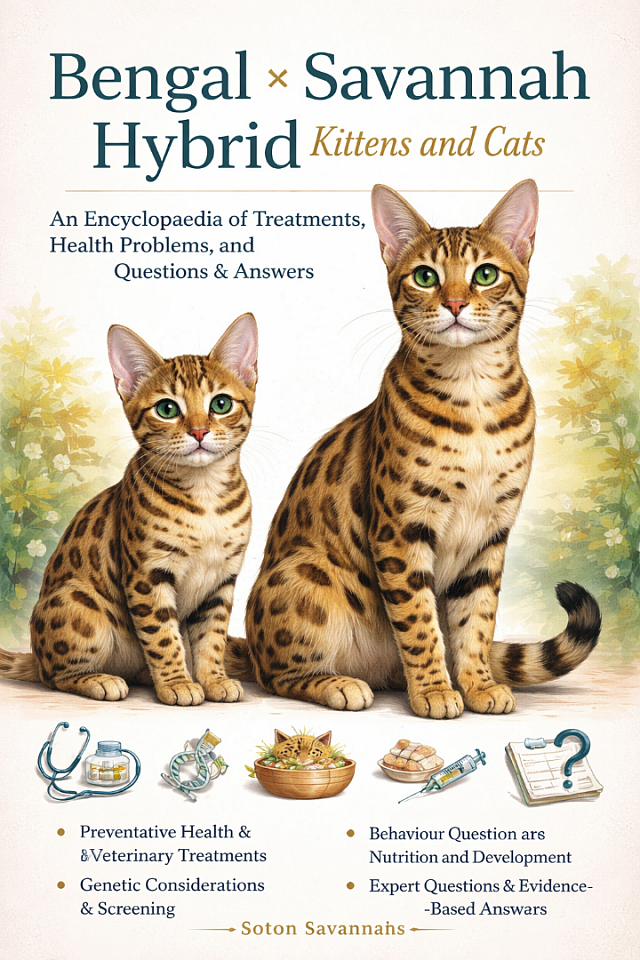
https://publuu.com/flip-book/1002952/2352994
Bengal × Savannah Hybrid Kittens and Cats: An Encyclopaedia of Treatments, Health Problems, and Questions & Answers
